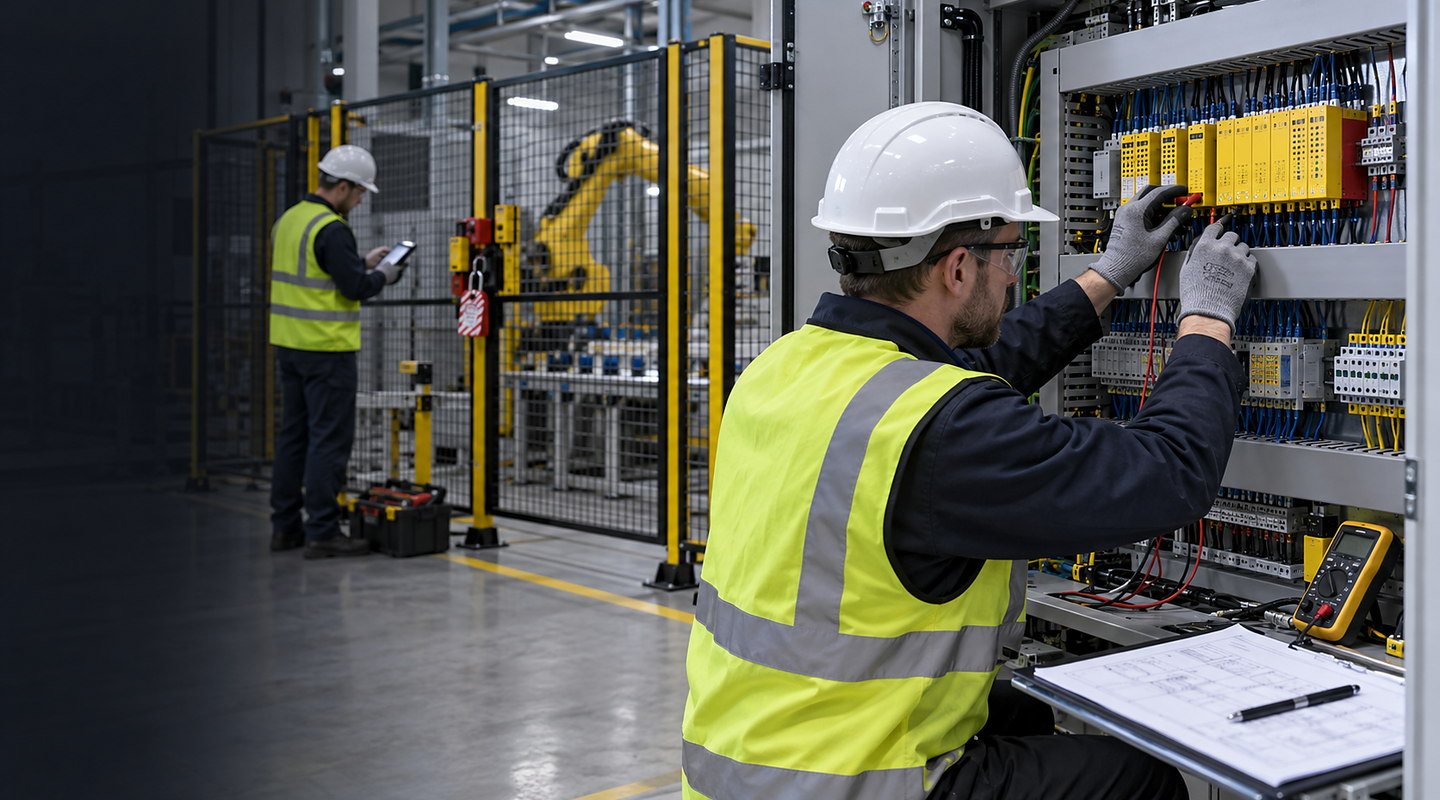
Migration From Obsolete or Fragmented Safety-Control Hardware
Plan migration from obsolete or fragmented safety-control hardware around the actual machine, defined safety functions, device list, drawings and stopping behaviour, line connections, operating limits, acceptance checks and next steps.
In brief
For migration from obsolete or fragmented safety-control hardware, start with the actual machine, defined safety functions, device list, drawings and stopping behaviour and your full operating sequence, then check fault, mode, reset, restart, diagnostics and foreseeable intervention scenarios before committing to a final layout.
Plan a machine safety PLC project around defined safety functions, inputs, safe outputs, operating modes, reset and restart behaviour, diagnostics, controlled software and validation evidence.
On the production floor
Plan for the conditions your team handles every day — Machine Safety PLCs
Plan a machine safety PLC project around defined safety functions, inputs, safe outputs, operating modes, reset and restart behaviour, diagnostics, controlled software and validation evidence. For migration from obsolete or fragmented safety-control hardware, the deciding details include required safety functions and safe states, safety PLC hardware, program and version control and drawings, software records and validation evidence.
Details worth resolving early for migration from obsolete or fragmented safety-control hardware
Question 1
Required Safety Functions and Safe States
For migration from obsolete or fragmented safety-control hardware, describe the current position, required outcome, acceptable limits and known exceptions for required safety functions and safe states. That lets us compare options against your real production rather than one nominal value.
Question 2
Input Devices, Zones and Operating Modes
For migration from obsolete or fragmented safety-control hardware, describe the current position, required outcome, acceptable limits and known exceptions for input devices, zones and operating modes. That lets us compare options against your real production rather than one nominal value.
Question 3
Safety PLC Hardware, Program and Version Control
For migration from obsolete or fragmented safety-control hardware, describe the current position, required outcome, acceptable limits and known exceptions for safety PLC hardware, program and version control. That lets us compare options against your real production rather than one nominal value.
Question 4
Safe Outputs, Drives and Standard-Control Interfaces
For migration from obsolete or fragmented safety-control hardware, describe the current position, required outcome, acceptable limits and known exceptions for safe outputs, drives and standard-control interfaces. That lets us compare options against your real production rather than one nominal value.
Question 5
Reset, Restart, Diagnostics and Recovery Behaviour
For migration from obsolete or fragmented safety-control hardware, describe the current position, required outcome, acceptable limits and known exceptions for reset, restart, diagnostics and recovery behaviour. That lets us compare options against your real production rather than one nominal value.
Question 6
Drawings, Software Records and Validation Evidence
For migration from obsolete or fragmented safety-control hardware, describe the current position, required outcome, acceptable limits and known exceptions for drawings, software records and validation evidence. That lets us compare options against your real production rather than one nominal value.
Your operating cycle
Plan every mode, fault response and validation step
For migration from obsolete or fragmented safety-control hardware, include normal operation, setup, access, faults, reset, restart and maintenance. The selected device is only one part of the complete safety function.
Defined safety functions and safe states
Every operating and access mode
Fault, reset and restart behaviour
Controlled drawings, software and validation records
Prove the result
Test migration from obsolete or fragmented safety-control hardware against defined safety functions and representative fault and operating scenarios
Normal and access modes
Verify the intended response for required safety functions and safe states in each relevant operating and access mode.
Fault challenges
Introduce agreed faults affecting input devices, zones and operating modes and confirm the safe response and diagnostics.
Reset and restart
Prove that reset, restart and recovery behave as specified, then retain drawings, software records and validation evidence.
Important limits
Be clear about what the trial has shown
A safety PLC does not make an inadequately defined safety function acceptable.
Hardware and software changes require controlled versions and validation of the complete function.
Required risk reduction and final conformity responsibilities remain machine-specific.
Treat obsolescence migration as a controlled redesign, not a code-copy exercise
Decide whether a safety PLC is appropriate for defined safety functions, zones and modes, and understand the engineering and validation scope around it.
Evidence to compare
Capture existing drawings, hardware, program, versions, field devices, stopping behaviour and undocumented changes.
Production condition
reproducing old logic does not prove the required safety functions are adequate.
Acceptance decision
Require staged testing, fault challenges, backups and an approved handover record.
The quotation brief should record diagnostics, fault response and recovery and validation plan, records and future change ownership. Final suitability remains specific to the samples, line conditions and acceptance tests agreed for your project.